

Is Your Card Deck Just a Document? The Docudeck Problem

I love card decks. I design them for a living and I keep buying other people's. So please read what follows as coming from a friend of the family.
A lot of serious card decks are documents in disguise.
You've seen them. A beautiful box. Fifty-two cards, each one carrying a method, a principle, a coaching question, a leadership insight. The content is often genuinely good. And the only thing anyone ever does with these cards is read them, one at a time, in whatever order the box happened to preserve.
I made up a word for this: docudeck. A contraction of document and deck. A docudeck is a document that got cut into 52 pieces and sold in a box.
The PDF test
Here's how you spot one. Take the deck and imagine printing the exact same content as a PDF, a booklet, or a slide series.
If nothing is lost, you're holding a docudeck.
That's the whole test. A real deck loses something essential when you flatten it into pages, because a real deck asks you to do something with the cards that pages can't do. A docudeck loses nothing, because it never asked you to do anything except read.
I want to be precise here, because this can sound harsher than I mean it. A docudeck can contain excellent content. What bugs me is paying for the most expensive, most interactive format in publishing and then using none of its powers. Cards cost more to print than pages. They're harder to store than a book and far more annoying to read in sequence. If reading in sequence is all your deck offers, a booklet beats it on every count.
What passive reading actually costs
You could shrug and say fine, it's a book with extra steps, no harm done. But there's a real cost, and learning science has been documenting it for decades.
Reading is passive engagement. The ICAP framework, one of the most cited models in educational psychology, ranks how people engage with material: passive, active, constructive, interactive, in increasing order of learning effect (Chi and Wylie, 2014). A meta-analysis covering 225 classroom studies found the same direction: doing something with material beats passively receiving it (Freeman et al., 2014). A docudeck keeps its users parked in passive mode. The card format visually promises interaction and then delivers a reading assignment.
It gets worse. Re-reading, the natural way people use a content deck they already went through once, ranks among the weakest study strategies we know of. It raises familiarity, which feels like learning but decays fast, producing what researchers call an illusion of mastery (Dunlosky et al., 2013). Roediger and Karpicke showed it memorably in 2006: students who actively recalled a text retained 61 percent after a week, while students who re-read it repeatedly kept 40 percent. Your docudeck's owner flips through it on the shelf, feels smart, and remembers little.
Cards can do so much better than that. Which brings me to what cards are actually for.
What a card can do that a page can't
Researchers who study design cards have a nice list of what makes cards special as physical objects: you can point at them, rotate them, arrange them, write on them, and combine them in ways that spark ideas that wouldn't meet otherwise (Lucero et al., 2016). Cards let a group literally hold a thought and come back to it later (Yeoman and Carvalho, 2019).
And there's one move that belongs to cards alone, my personal favorite: the flip.
A card has two faces and you only see one at a time. Flipping it is a tiny act of revelation. Something was hidden, you made a gesture, now it's visible. That structure, question on the front and answer on the back, turns a card into a retrieval machine. And retrieval, actively pulling an answer from your own head before checking, is exactly the mechanism behind that 61 versus 40 percent result. A well-designed flip card makes you commit to a guess before you turn it over. A page can't hide anything from you. A card can, and the hiding is the point.
The flip is just one move among many. You can hold cards secretly and reveal them all at once, which is how Planning Poker kills the anchoring bias: nobody's estimate can influence yours if every estimate is locked before any is visible (Tversky and Kahneman described the bias in 1974; agile teams built the countermeasure into a deck). You can shuffle and draw, injecting the randomness that creativity techniques have used for decades to knock thinking out of its ruts. You can deal, give, steal, sort, order, and combine. I call these play patterns: the physical moves a deck invites, each one exploiting something a card is that a page isn't.
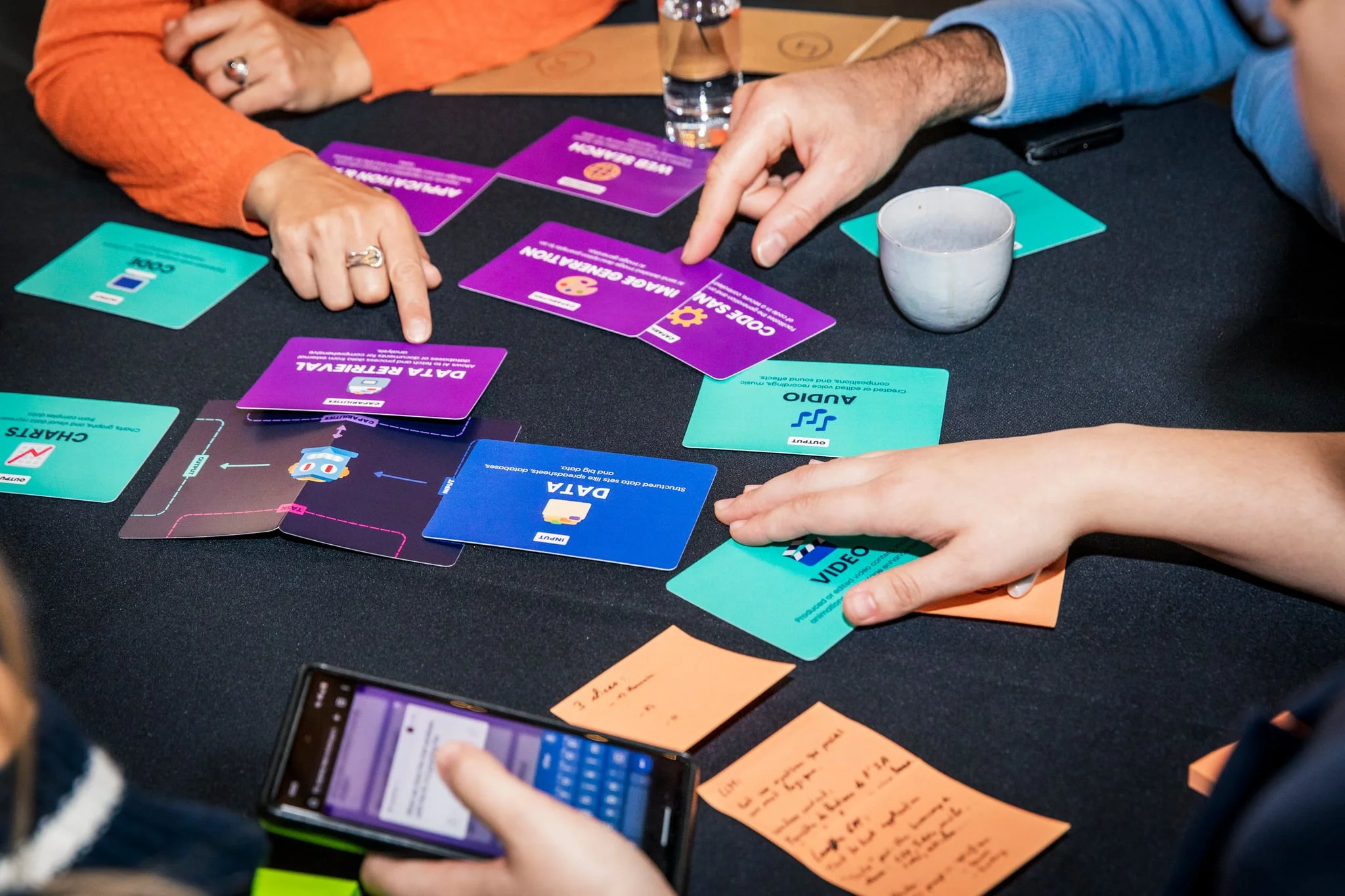
Here, participants combine AI Tinkerers cards to create combinations representing concrete AI use cases.
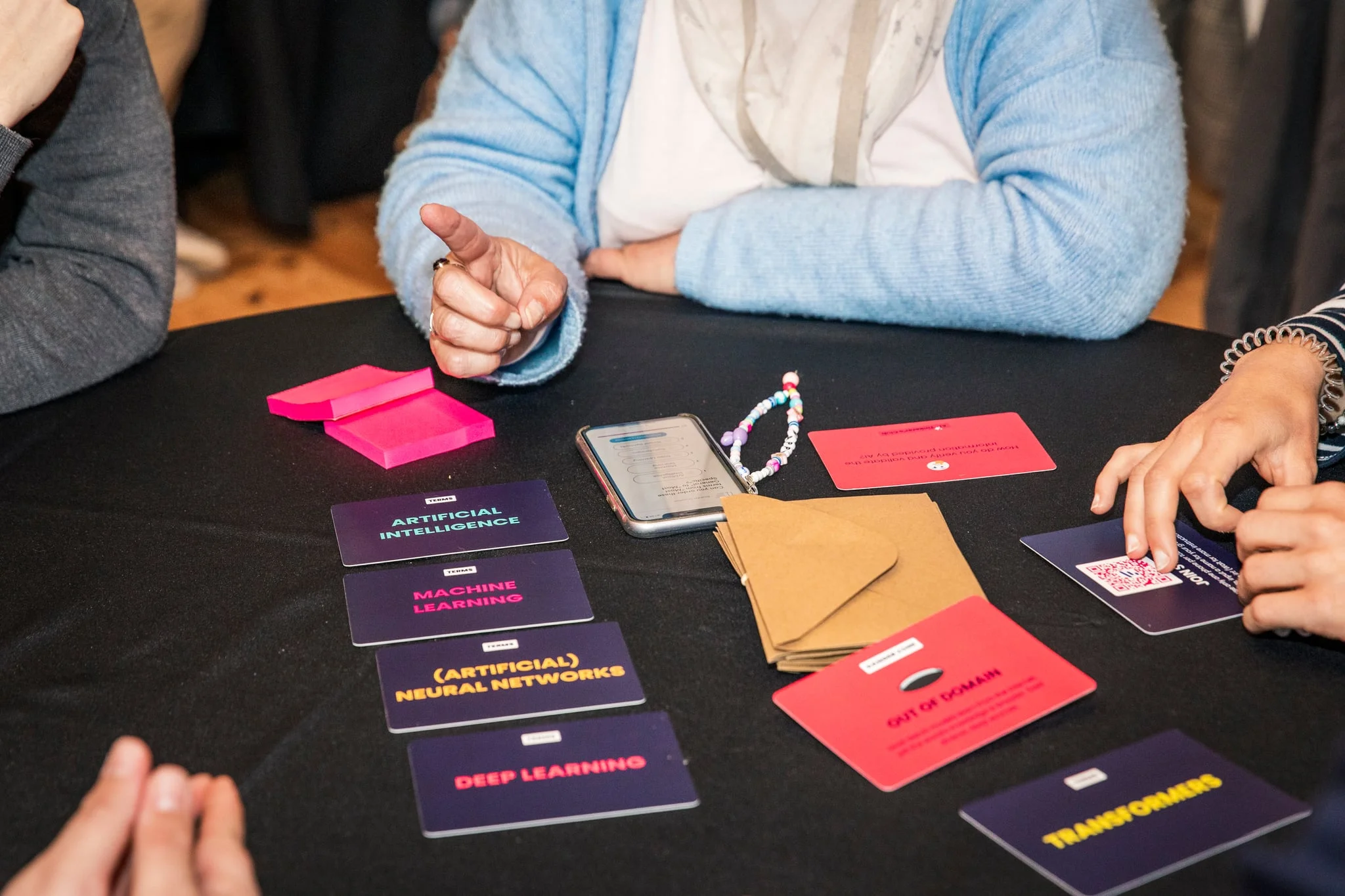
In another AI Tinkerers play pattern, participants reorder AI concepts from broadest to most specific.
The study that argues against me
There's one more study to show you, and it doesn't play for my team. The most complete academic review of card-based tools looked at 155 decks and found that almost none of them have ever been tested in a proper trial (Roy and Warren, 2019). The claim at risk is the one every deck maker just assumes, mine included: that a card deck produces better results than the same content in another format. That claim is unproven. The few evaluations that exist mostly measure whether people liked the deck, and people usually did, which tells us about enjoyment, not outcomes. And in one of the rare controlled experiments, a design card deck was pitted against a plain directed brainstorming method: the deck made ideation no faster and the results no better. The only thing it clearly won was preference. Participants enjoyed it more.
So no, cards aren't magic. And honestly, that finding supports my point rather than undermining it. Look closely at those studies and you'll notice what they actually back are specific interactions: retrieval, simultaneous reveal, random stimulation, doing over reading. The deck is just the vehicle. A deck with no interaction is a vehicle with no engine, and it doesn't matter how nice the paint job is.
The one-question test
So here's the rule I now apply to every deck I design, and the principle I'd offer to anyone building one.
Design your deck around at least one play pattern. One primary move, maybe a second one to support it.
You don't need to stack five mechanics into one product. One deliberate pattern is enough to move your users out of passive mode. Question fronts with answer backs. A secret hold with a synchronized reveal. A spread people walk around and pick from. A pair of cards that only make sense combined.
And the test fits in one question: what is your deck's primary play pattern?
If you have an answer, you designed a deck. If you don't, you designed a very expensive booklet, and your users' shelves are already full of those.
I'm building a full catalog of these play patterns, from the flip to the steal, as a living document that will grow over time. That's the next article. If you've got a pattern I should know about, I genuinely want to hear it.
Sources
- Chi, M. T. H., & Wylie, R. (2014). The ICAP framework: Linking cognitive engagement to active learning outcomes. Educational Psychologist, 49(4), 219–243.
- Freeman, S., et al. (2014). Active learning increases student performance in science, engineering, and mathematics. PNAS, 111(23), 8410–8415.
- Dunlosky, J., et al. (2013). Improving students' learning with effective learning techniques. Psychological Science in the Public Interest, 14(1), 4–58.
- Roediger, H. L., & Karpicke, J. D. (2006). Test-enhanced learning: Taking memory tests improves long-term retention. Psychological Science, 17(3), 249–255.
- Lucero, A., Dalsgaard, P., Halskov, K., & Buur, J. (2016). Designing with cards. In Collaboration in Creative Design (pp. 75–95). Springer.
- Yeoman, P., & Carvalho, L. (2019). On cards as material anchors in collaborative design.
- Tversky, A., & Kahneman, D. (1974). Judgment under uncertainty: Heuristics and biases. Science, 185(4157), 1124–1131.
- Roy, R., & Warren, J. P. (2019). Card-based design tools: A review and analysis of 155 card decks for designers and designing. Design Studies, 63, 125–154.
How I use MCP connectors and AI to design my workshops
How one Claude conversation orchestrates SessionLab, Stormz, I Love Cards, and Gmail from workshop design through final reporting.
Play Patterns: A Design Vocabulary for Card Decks
A living catalog of reusable card interactions, from flipping and stealing to grouping, combining, and simultaneous reveal.