
Get Those Cards Off the Table: 9 Ways to Combine Cards and Movement

I've been writing about movement in workshops lately: the 10 movement patterns hiding in every activity, and how to make people actually move in remote sessions. And of course, my card brain kicked in.
A card is a physical object. It fits in a hand, a pocket, the air between two people. And yet in most workshops, decks stay flat on the table while everyone sits around them.
Here are 9 ways to fix that. All tested or stolen from people smarter than me.
1. The card swap walkabout
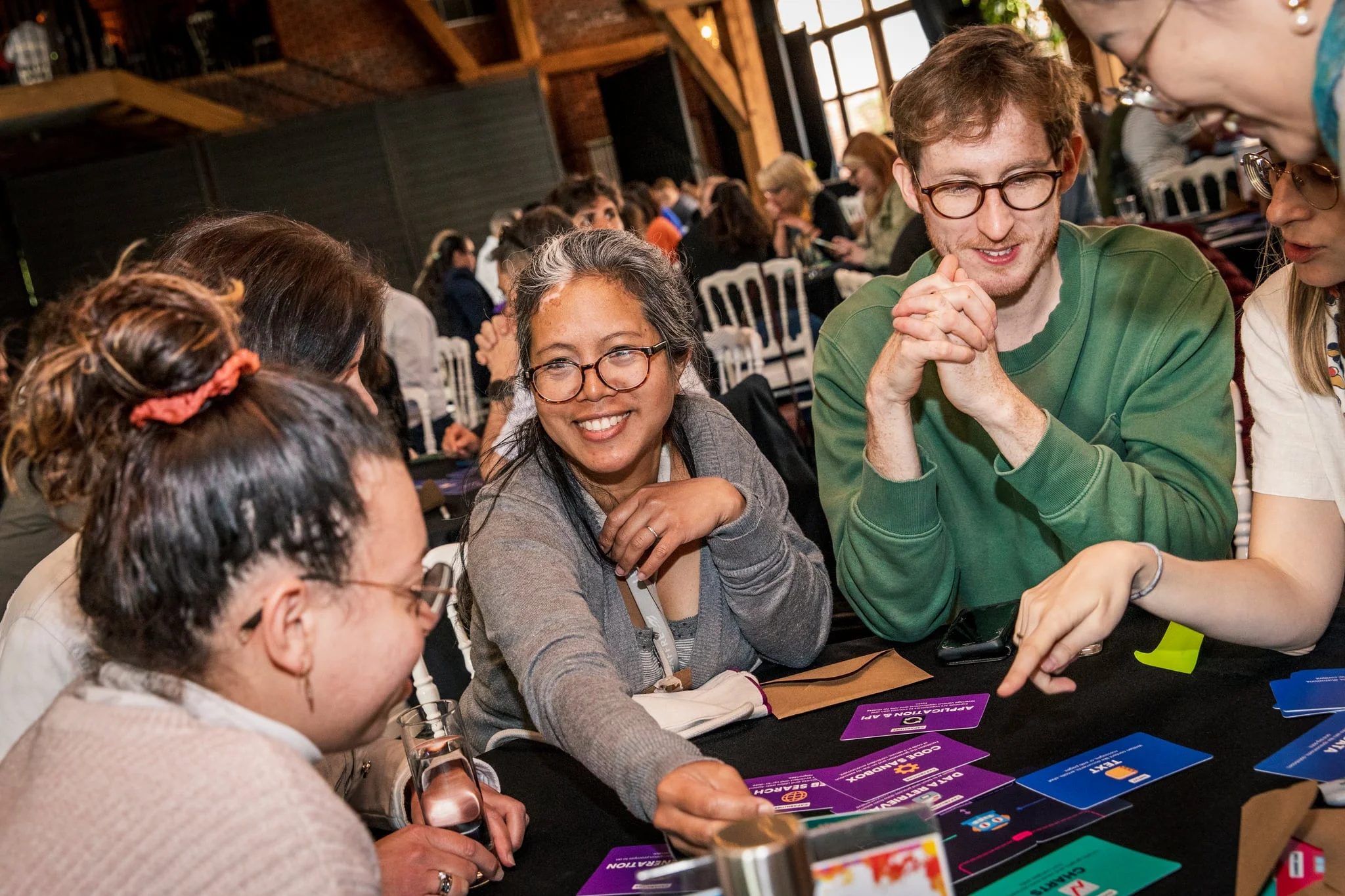
Everyone draws a prompt card. People wander the room, music plays. Music stops: discuss your card with the nearest person. Before the music restarts, swap cards. Next round, you're defending someone else's question.
The swap is the trick. Ideas travel between conversations without you doing anything.
2. The pocket agenda
Sending pairs on a walk & talk? Give each pair one card to take along. The card is the agenda in their pocket: a question to chew on, a scenario, a provocation. When they drift off topic (they will), the card pulls them back. No facilitator needed for 20 minutes.
3. Card speed-dating
Two lines facing each other. Everyone holds a card with an idea on it. Two minutes: pitch your card, listen to theirs, then each writes a quick note or score on the other's card. Shift one position. After five rounds, every card carries five reactions from five different people.
At the end, nobody presents their own idea. You present the card you're holding, with its five annotations. Egos left the building five rounds ago.
4. Sort with your feet
Instead of sorting cards on a table, sort them in the room. Mark zones on the floor (keep / drop / discuss, or whatever your categories are). Everyone draws a card, reads it out, walks it to its zone. Disagreement about where a card belongs? That's the workshop working. Let two people tug on it verbally for a minute.
Bonus: at the end, the room IS your sorted board. Take a photo from a chair.
5. The wall deck
Pin the cards on the walls, spread out, and let people circulate with a pen and dot stickers. Comment, vote, add. Works especially well with big decks: nobody reads 40 cards sitting down, but everybody browses 40 cards on a wall.
Quick tip: in I Love Cards you can resize a deck in one click, so you can print a bigger version of the same deck just for the wall. Standard size in hands, poster size on walls.
6. The card courier
Groups work at separate tables, each with their own cards. Every 10 minutes, one person from each table picks ONE card from their table's work and carries it to another table: "here's our best one, what do you make of it?" Then they return with one of the other table's cards.
Cards migrate, ideas cross-pollinate, and only one person per group ever leaves their chair.
7. Deal, don't hand out
Small change, real effect: instead of placing the deck on the table, deal the cards like a poker hand, or better, make people draw blind from a fanned deck. Drawing a card is a tiny physical ritual, there's suspense in it, and people feel ownership of "their" card. A card you drew is a card you defend.
8. The card toss
Yes, you can throw them. Everyone writes on a blank card, then on the count of three, all cards fly to the center of the room. Pick up someone else's, respond to what's on it. Anonymous, fast, and mildly chaotic in the best way.
Cards fly better than crumpled paper, they survive the flight, and they stay readable. Frisbee physics on your side.
9. The home draw (remote)
For remote sessions: share the deck digitally and let each participant draw a random card (or simply draw one card yourself and show it to everyone). Then everyone has 2 minutes to walk through their home and bring back an object that matches it. Camera on, show your card, show your object, explain the connection.
The card gives the mission a frame; the object makes it personal. I've seen a "what does resistance to change look like?" card come back paired with a jar of pickles nobody could open. Ten minutes of conversation from one jar.
None of this needs special equipment. A deck, a room, sometimes music, sometimes a wall. The common idea behind all nine: a card wants to be held, carried, traded, and occasionally thrown. Let it.
If you want the theory behind why moving works so well in workshops (there's real research: walking, memory, proximity), I wrote about the science here, and about the full set of movement patterns here.
Now deal the cards. And push the chairs back first.