

BMC Building Blocks
(Re)Invent Your Business Model

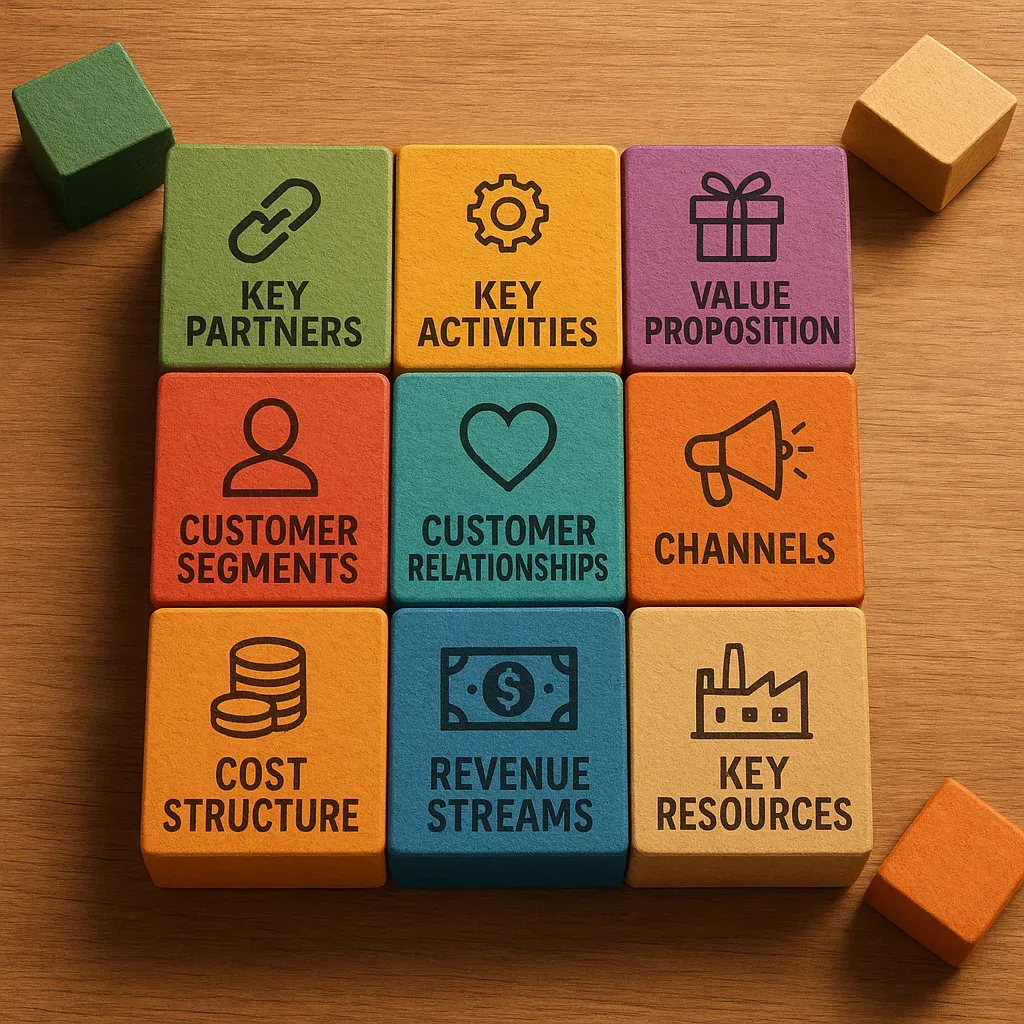
This deck helps you invent and reinvent business models using the Business Model Canvas (BMC) by Alexander Osterwalder and Yves Pigneur.
Value Propositions
WHAT value do you deliver to each customer segment? The products, services, and benefits that solve customer problems or satisfy their needs.
Opening access to products or services that were previously unavailable or hard to reach.
Creating emotional benefits or enabling customers’ desired lifestyles.
Offering the lowest prices or best value for money to price-sensitive customers.
Reducing customers’ financial, performance, operational, or emotional risks.
Being first, fastest, or most responsive to changing market needs.
Building trust through clear, honest, and transparent communication and practices.
Differentiating through attractive product design, visual appeal, and user experience.
Competing by offering superior quality, features, speed, or technical capabilities.
Making it easier, faster, or more accessible for customers to get and use your solution.
Delivering value through sustainable, ethical, or environmentally friendly practices.
Providing prestige, identity, or belonging through strong brand association.
Providing tailored products or services that match individual customer preferences.
Customer Segments
WHO are you creating value for? Different groups of people or organizations with distinct needs that you’re serving in your business.
Segmenting customers by usage frequency, purchase patterns, or behavioral characteristics.
Serving multiple related customer groups with tailored variations of your offering.
Connecting interdependent customer groups that create value for each other.
Distinguishing between business customers and individual consumers with different strategies.
Segmenting customers by country, region, city, or rural/urban location.
Segmenting customers by values, beliefs, attitudes, interests, and lifestyles.
Serving two or more unrelated customer segments with fundamentally different needs.
Serving a highly specific, specialized customer group with distinct needs.
Segmenting customers by age, gender, income, education, family status, or lifestyle.
Serving a broad, undifferentiated customer base with similar needs.
Segmenting customers by the jobs, tasks, or outcomes they are trying to achieve.
Channels
HOW do you reach your customers and deliver your value proposition? The ways you communicate with and deliver value to your customer segments.
Selling directly to customers via your own online store or platform.
Selling through independent agents or brokers on a commission basis.
Driving sales via affiliates or partners who earn commission on referred customers.
Selling in bulk to intermediaries who supply retailers or resellers.
Selling through third-party digital marketplaces and social commerce platforms.
Selling directly to customers through a company-employed sales team.
Using a mix of direct and indirect channels to reach different customers.
Expanding through franchisees who operate branded locations under license.
Selling products through third-party physical or online retail outlets.
Reaching customers via partners who extend your platform with integrations or apps.
Key Activities
WHO are you creating value for? Different groups of people or organizations with distinct needs that you’re serving in your business.
Creating or curating content as a core way of delivering value.
Operating and maintaining a platform where different users interact or transact.
Building awareness and acquiring customers through marketing and branding.
Designing and delivering tailored solutions to specific customer problems.
Designing and producing products or deliverables for customers.
Researching and developing new products, features, or technologies.
Key Resources
WHAT assets do you need to make your business model work? The most important physical, intellectual, human, and financial assets required.
Leveraging strategic relationships and alliances as critical assets.
Using cash, credit, or investment capital to fund operations and growth.
Using logistics, supply chain, or fulfillment capabilities to deliver value.
Leveraging patents, trademarks, copyrights, and brand reputation as key assets.
Using software, platforms, algorithms, or infrastructure as core enablers.
Relying on people’s skills, knowledge, and experience to run the business.
Using tangible assets like buildings, equipment, or inventory to create value.
Using collected customer data and insights to drive decisions and personalization.
Key Partners
WHO do you work with to make your business model work? The network of suppliers, partners, and strategic alliances that help you operate.
Partnering with franchisees who own and operate locations under your brand.
Partnering with others who build on or integrate with your platform.
Collaborating with competitors on shared interests while still competing.
Creating a new jointly owned entity with partners for a specific purpose.
Partnering with non-competing companies for mutual advantage.
Building strong, reliable relationships with key suppliers or vendors.
Customer Relationships
WHAT type of relationship do you establish with each customer segment? The links you create between your business and each customer segment to acquire, retain, and grow them.
Enabling customers to complete tasks and solve problems independently.
Providing one-on-one human support through account managers or service staff.
Engaging customers directly in designing, improving, or testing offerings.
Maintaining ongoing relationships through recurring payments for access or benefits.
Handling one-off purchases with little or no ongoing relationship.
Rewarding repeat customers with points, perks, or exclusive benefits.
Creating communities where customers connect, share knowledge, and support each other.
Providing continuous management or maintenance of customer outcomes over time.
Using automated systems or AI to handle routine customer interactions at scale.
Cost Structure
WHAT are your major costs? All the costs incurred to operate your business model.
Continuously lowering costs through process, technology, or efficiency improvements.
Structuring the business around either lowest cost or highest value.
Reducing unit costs as volume grows by spreading fixed costs.
Incurring costs that do not change with production or sales volume.
Managing costs that contain both fixed and variable components.
Incurring costs that rise or fall directly with activity or volume.
Revenue Streams
HOW do you earn money from each customer segment? The cash a customer segment generates for your business from your value propositions.
Offering a free basic tier with optional paid upgrades or premium features.
Earning commissions from sales generated by referring customers to others.
Earning revenue from one-time sales of physical or digital products.
Offering multiple pricing tiers with different feature sets or service levels.
Earning revenue by selling advertising access to your audience.
Earning commission on transactions between buyers and sellers you connect.
Earning predictable revenue from regular, recurring customer payments.
Earning fees on transactions processed through your platform or marketplace.
Earning revenue from selling data, insights, or analytics derived from users.
Earning revenue by renting or leasing assets instead of selling them outright.
Earning revenue by selling expertise, advice, or implementation services.
Charging customers based on their actual usage or consumption.
Earning fees by licensing intellectual property or technology to others.