
Why Cards Are Such a Great Tool for Trainers and Workshop Facilitators

If you're running workshops on complex topics: AI, strategy, innovation, whatever; you need tools that help people engage with new concepts, not just hear about them.
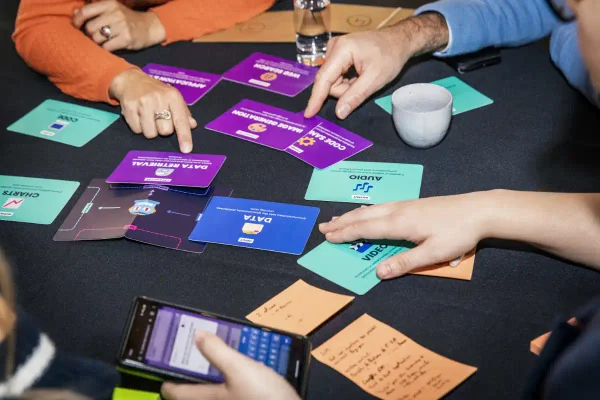
Here's why facilitators and trainers keep coming back to cards.
Make learning more fun and engaging through physical interaction
Cards are objects. You shuffle them. Pick one. Pass it to someone. Hold it while you think.
That physical interaction changes how people show up. They're not just absorbing information—they're doing something with it.
Support hands-on, kinesthetic learning styles
Some people learn by listening. Some by seeing. Some need to move and touch to understand.
Cards work for all of them, but especially the kinesthetic learners who zone out during slide decks.
When someone picks a card, reads it, and physically places it on a table to categorize it, they're learning through action. That sticks.
Foster collaboration and teamwork between participants
Cards create natural collaboration points. "Which one should we pick?" "What does this one mean?" "Let's sort these together."
You don't have to engineer collaboration activities. The cards do it for you.
Allow for flexible, spontaneous activities and exercises
Cards give you flexibility. You can:
- Let participants pick randomly
- Sort them into categories that emerge organically
- Use them for different activities than you originally planned
- Adjust on the fly based on what the group needs
The structure is there, but it doesn't constrain you.
Help participants retain workshop content longer
The act of choosing a card, discussing it with a partner, and using it to solve a problem creates a memory anchor.
Weeks later, they might not remember the exact wording, but they'll remember the card they picked and what it helped them understand.
Transform abstract AI concepts into tangible, easy-to-grasp ideas
This is where cards really shine for complex topics like AI.
"Machine learning" is abstract. A card that says "What biases might be hidden in your training data?" with a concrete example—that's something you can hold, discuss, and apply.
Cards take concepts that live in theory and make them feel real and actionable.
What this means for your workshops
If your goals include:
- Getting people to engage with the material
- Supporting different learning styles
- Making complex topics accessible
- Creating memorable learning experiences
Cards are worth trying.
For the parts of your workshop where engagement and understanding matter most, give cards a shot. The difference will be obvious.
Want to learn how card decks can grow your business?
Join me for a free webinar: I Love Cards, Your Client Will Too!
I'll share practical (and unexpected) ways card decks can support your business as a facilitator, trainer, or consultant.
Fair warning: you may leave wanting to create your own deck.